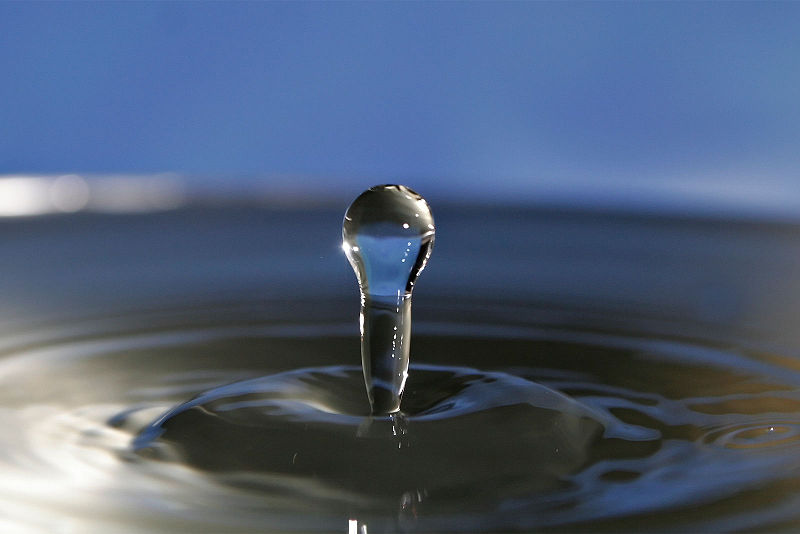
 image from: http://en.wikipedia.org/wiki/File:Water_droplet_blue_bg05.jpg
The Xinhua News Agency said that China’s population is estimated to reach 1.6 billion by 2030, which will cause the available drinking water per capita to drop from 1.760 cubic meters to 1,700cubic meters (3). To accentuate the dilemma, the Chinese Institute of Public and Environment Affairs (IPE) has said that the water pollution in China is on the rise and is further stressing China’s water supply (4). The IPE has collected data, graphically showing the concentration of pollution in China. Not surprisingly, the areas with the highest water pollution are those with the largest population and industrial manufacturing concentration. To see the interactive pollution map, click here.

What does all this mean? It means that China is expected to face massive water shortages in the near future that will be further accentuated by pollution.
Is there a solution in the near future? As many of us know, the most governments subsidize and regulate the basic utilities (such as electric and water), and China is no different. In 2008, China faced a similar water crisis due to the upcoming Olympics and several local droughts. Regretfully I cannot find the article that I read about this, but I will recount it to the best of my abilities. There were water shortages reported all over China, to solve this the Chinese government temporarily lift the price ceiling on water, allowing the market to climb up to the equilibrium point. While this raised the price of water, it also lowered the demand for water, alleviating the shortage.
Businesses were the main culprit in the water shortage. While the price of water was cheap, businesses would engage in “Morally Harzardous” activities… Aka, wasting water and not caring, since it was so cheap. But as the price of water climbed the businesses became more responsible with their usage of water (since it was hitting them in their wallets).
This poses an interesting dilemna. As Kyle pointed out in class, the market when left alone will reach maximum efficiency (in a perfect world), but in so doing they (the businesses) often pollute and destroy the environment.
I’d love to hear your thoughts. Do you think there is a way to balance all the benefits that a free market has economically, while also reducing the effect that the market has on the environment? Are we currently practicing these methods? Is there anything that you think our government (or people) could do to promote this balance?
1: http://en.wikipedia.org/wiki/People%27s_Republic_of_China
2: http://en.wikipedia.org/wiki/The_United_States
3: http://www.china.org.cn/english/SO-e/33957.htm
4: http://www.ipe.org.cn/index.jsp

Wow, this is not only an interesting topic, but I feel that many people aren't even aware of the reality of the water crisis, not only in China, but around the world. Countries such as Sudan, Venezuela, Zimbabwe, and Tunisia are among the countries with the most population whose only consumption is contaminated water. Getting back to the situation in China, I think that its an issue that the world has to circumvent together. This is not only an economic issue, but moreso an ecological one. People will get water one way or the other, but the quality of the water is the real question.
ReplyDeleteChina, in relation to many countries facing water shortages, is actually in relatively good position. Shortages occur mainly in the northern half of the country and are similar to those in the US Southwest (but given that infrastructure and distribution patterns vary, the effect on the Chinese people is likely more debilitating).
ReplyDeleteAccording to Lester R. Brown and the United Nations Development Program, countries with an annual supply of 1,700 cubic meters of water per person (like China) is "well supplied with water, able to comfortably meet agricultural, industrial and residential needs. Below this level, issues arise. According the to UNDP, at below 500 cubic meters, a population suffers from hydrological poverty.
This is mostly a problem in the Middle East and Africa. Algeria, Tunisia and Libya have less than 500 cubic meters per person. Saudi Arabia, Yemen, Kuwait and Israel have less than 300 cubic meters per person.
In any case, water scarcity has led to conflict and will surely lead to further conflict if the problem goes unaddressed. In many countries, (Pakistan and Kenya, for example) water shortages have led to surges in violence. Countries facing an influx of refugees are also at risk, as large numbers of people pump more water than aquifers can sustain or replenish, leading to a scarcity with sometimes serious consequences for populations lacking political representation and who are dependent on their host country for safety. On that same thought, distribution is often far from equitable. In Israel, for example, 300 cubic meters of water creates a serious shortage for the entire population. However, despite the fact that the Israeli population is only double the Palestinian population, they get seven times as much water. Thus, the shortage places extra pressure on the peace process.
I think this is an issue we will see become much more complicated in our lifetime, especially when compacted with growing populations, global warming and the expansion of deserts, and border conflicts.
OK. There is a water shortage but as you stated, the price ceiling is set to protect the environment. While the price ceiling seems inefficient it is serving a purpose so I feel it is efficient. Humans seem to be short run actors who wish for LR outcomes. As we have thought to have mastered our environment we are discovering how folly that idea is. Organic laws exist for nature just as natural economic equilibrium does for markets. It seems to me that to allow natural market equilibrium without the environment included is not equilibrium at all. The equilibrium that comes about from a seemingly imperfect market is painful and brutal but its alternative seems much more so. I could put it in terms of a payoff matrix. I agree the problem is disconcerting. I hope that governments learn to better manipulate markets in other ways without ceilings/floors. Maybe that is what the population control is concerning. It will be interesting to see what will come about regarding Las Vegas and Phoenix since their water supply has been depleting for years, from what I understand. I guess I wonder; while the system is in a constant struggle with various actors becoming stronger/weaker/exiting/entering are we able to achieve what is best or do we manipulate it, with best intentions, to a false, destructive, path. No, I did not smoke anything.
ReplyDelete